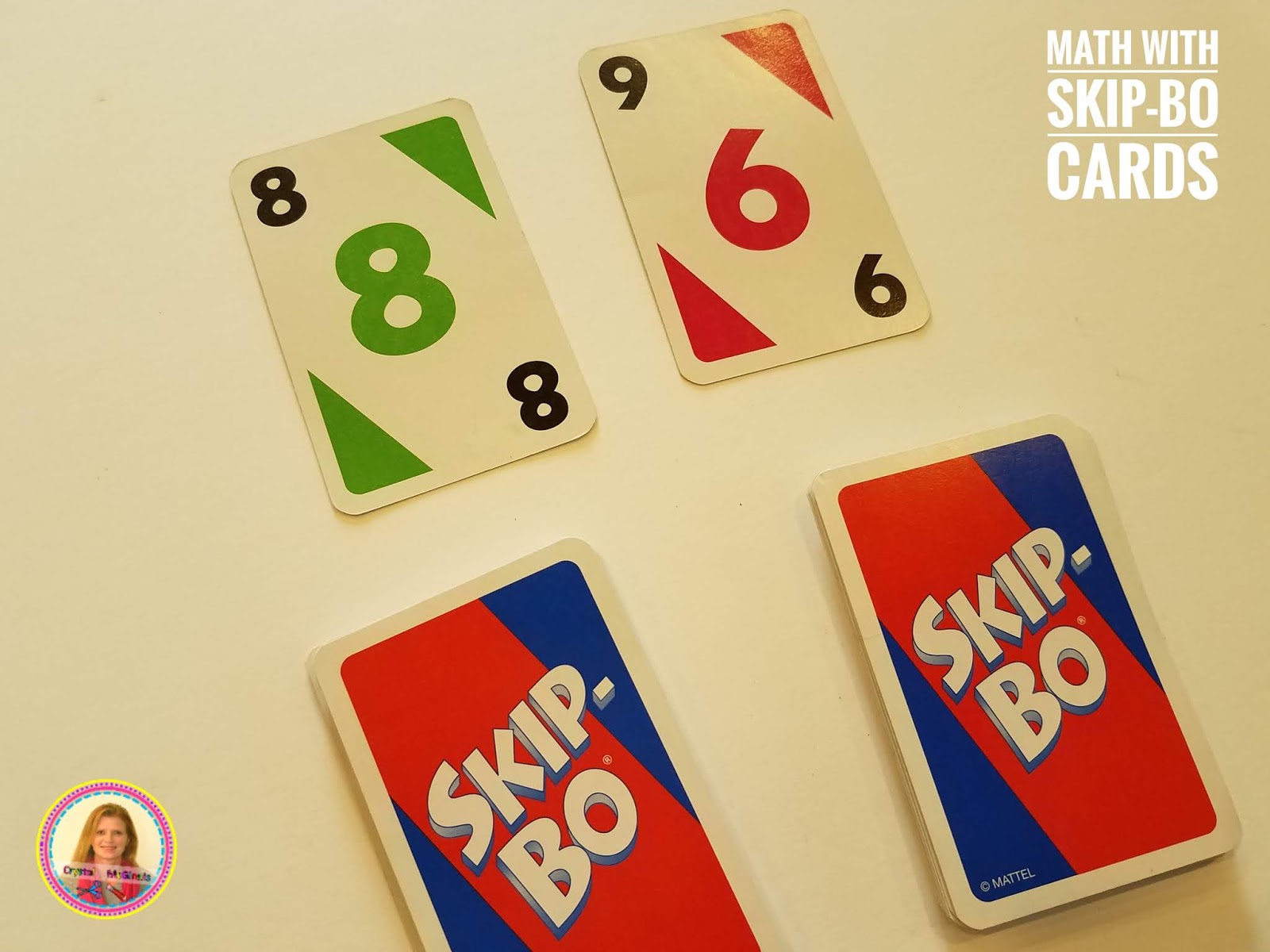
Math Games Using Skip-Bo Cards

Math Games Using Skip-Bo Cards


One of my favorite games as a child was Skip-Bo. I still play this game with my daughter, although it is not quite as memorable as it was when I was little. I was rummaging through our game closet, and discovered lots of old games that I could use for math centers for Kindergarten. Skip Bo was added to this pile. Skip Bo is perfect for little learners because the deck of cards has a lot of numbered sets 1-12, which is just about where our number recognition is at the beginning of school. The cards are thick and durable, which saves me time because no lamination is needed. Here are the activities that I thought of that Skip-Bo could be used for.

 Ordering Numbers-Place a deck of cards on the students' desks first thing in the morning with the numbers 1-12 all mixed up. The students practice ordering the numbers from 1-12. It is very surprising how difficult this can be for some students at the beginning of the year.

Clothespin Counting-Provide the students with a pile of clothespins. Let the students practice placing the correct number of clothespins on each card. This is perfect for number recognition, and one-to-one counting. Wal-Mart has clothespins for pretty cheap!

What is missing? Place students in pairs. Have each pair of students order a deck of cards from 1-12. One student closes their eyes, and the other student takes a card. When the first student opens their eyes, they have say what number is missing. Simple as that!


Old Fashioned Memory-Let two students play together with their decks of cards. The two students turn their cards upside down together. One student turns over two cards to try to make a match. The other does the same. When the game is over, the person with the most matches is the winner.
Comparing Numbers-This game resembles war! Two students take their deck of cards and turn them all upside down in separate piles. Both students flip over one card. The student with the highest number gets to keep both cards. Play continues until all cards are gone. The person with the most cards is the winner. Students must them sort the cards back into decks when they are done. This will help them practice number recognition, counting, and comparing numbers.

Domino Counting-Grab a bag of dominoes, and let your students match the number of dots on a domino to the number on the cards. This is perfect for number recognition, and one to one correspondence.

Number Towers-Provide your kids with building blocks. Students build towers to match the numbers on each card. They will love this!


Fill the Cup-Place a pile of Skip-Bo cards in an upside down pile. One person flips the top card over and places that many counters in their cup. Their partner then does the same, placing their amount of teddy bears in their cup. The first person to fill their cup is the winner!


Read more »
Crystal McGinnis
0 Comments
Kindergarten Math Centers

Kindergarten Math Centers


I am always looking for math center ideas for my kinders. One of the standards that kinders are expected to master is comparing numbers 1-10. I created this set of math tubs or math centers so that they can practice that standard using many different hands-on activities. They will use play-doh, teddy bear counters, building blocks, linking chains and more. I printed these using my instant ink account from HP, but I also created them in BLACK OR WHITE for those teachers who can't print in color.


Students build two different number amounts using balls created from play-doh. They then decide which number is greater and place a play-doh ball beside the greater number. All kinders seem to love play-doh, so this center will be a hit!


Students draw 2 numbers from a pile, and then count out the correct number of teddy bear counters to match each number. Students then place an alligator mouth representing greater than, less than, or equal to on the mat. This center practices one to one counting, number recognition, and comparing numbers.


Students use cubes to build two towers. Students use the height of their towers to compare the numbers. Simple as that!


Students practice counting by counting the fingers on each hand. Students decide which hand has more fingers showing, and they place a greater than, less than, or equal sign on the card.


Students build numbers using linking cubes. Students then draw a greater than, less than, or equal to sign on each card.


Students complete these clip-it cards by counting the objects shown on both sides. The cards have a variety of objects. The students then place a clothespin on the side that is greater.


Students practice creating sets that are greater using pennies and penny banks.


Students play a game of roll and compare. Students will roll 2 dice, and then place the correct amount of random counters on one side of the mat. Their partner will then do the same, and place their counters on the other side of the mat. They will then compare the numbers, and the person with the greater amount is the winner.

Students will practice the term "equal" by creating apple trees that have an equal number of apples using pom poms or play-doh balls.


This is just one set of math centers that I have created to use throughout the year. I have also created math centers for counting and numbers 1-10, 2-D Shapes, 3-D Shapes, Teen Numbers, Addition, Subtraction, and Measurement. You can check out these activities in my TPT store. Here is the link!


Read more »
Crystal McGinnis
0 Comments
Apple Centers for Kindergarten

Apple Centers for Kindergarten


It is time to set up those September centers! One of my favorite units to teach during September is apples.  I like to set up apple themed math and literacy centers around the middle of September. Here is what I have so far!


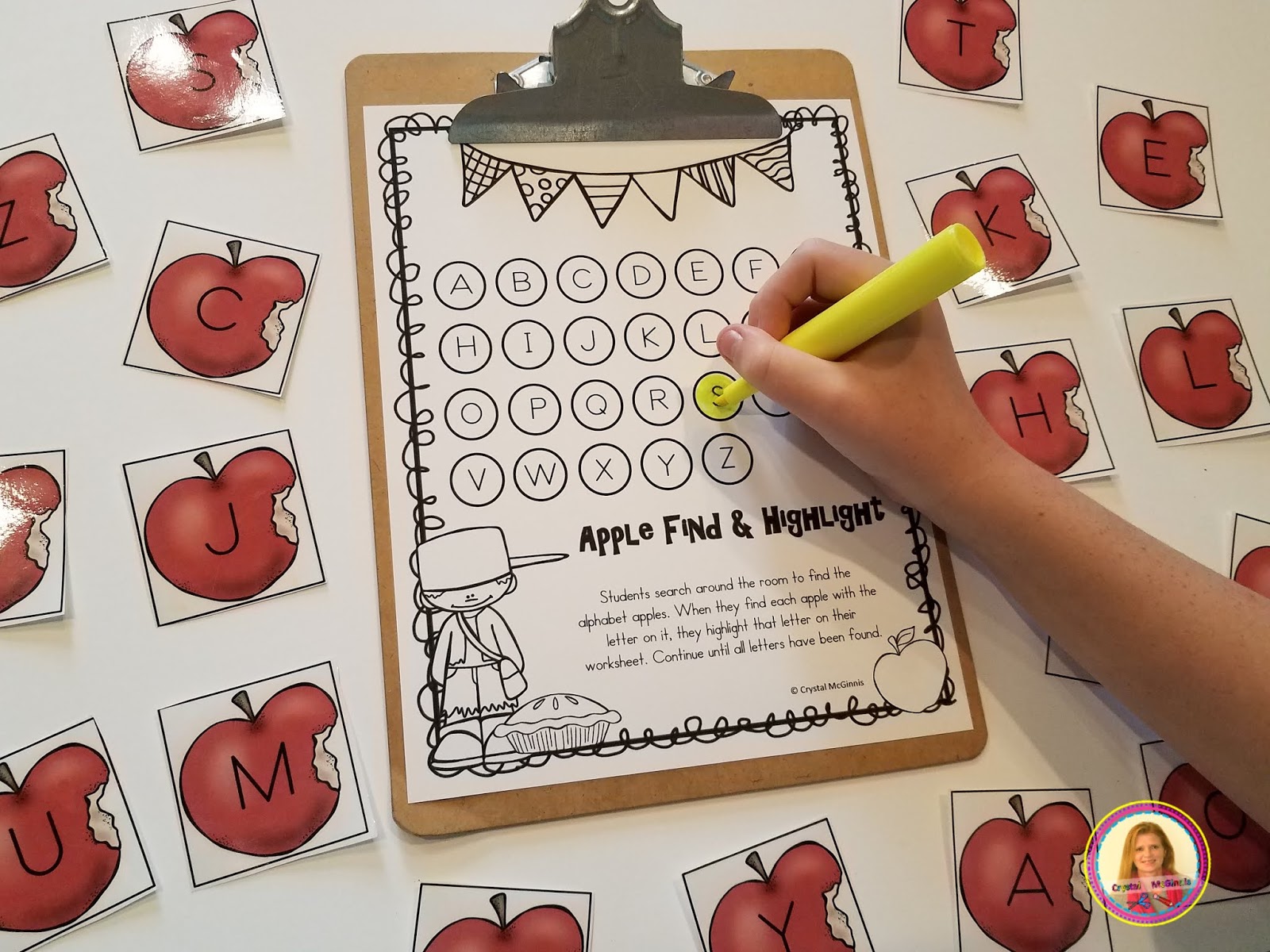
Alphabet Find & Highlight- I hang up these apple letters around the classroom. The students go on an apple hunt to try to find them. Once they find each apple, they highlight the matching apple on their provided printable. They love to use clipboards for this activity!


Apple Clothespin Clip It- Students clip the correct number of clothespins to apple cutouts. I have these apples to 20, but many of my students won't be ready for teen numbers. That is what I love about center time. You can differentiate for your different leveled learners.


Upper and Lowercase Matching-Students cut out the lowercase apples, and glue them next to the uppercase match. Simple as that!


Hole Punch Apple-Students cut out apples, color them, and then use a hole punch to punch the correct number of holes in each apple. This is a great activity for fine motor development at the beginning of school.


Pocket Chart Rhyming-I always keep a pocket chart center in the classroom. Students will match rhyming pictures in the pocket chart. They will then practice independently using the provided printable.


Play-Doh Apple Seeds-Students create the correct number of apple seeds using playdoh.


Apple Domino Match-Students count the dots on dominoes, and match them to numbered apples. We will practice number recognition, and one to one counting.


Alphabet Ordering-The students order the alphabet on a magnet board using these apples. I purchased magnetic 2 sided tape at Wal-Mart. It is very easy to use, and can easily create magnetic centers.


Apple Themed Roll & Cover- All of my kids love roll and cover! Students roll two dice, 
count the dots, and then color an apple with the matching number. The first student to have all apples colored is the winner. Simple!

If you would like my apple centers, you can grab them in my TPT store. They are just 2.00. Enjoy!


Read more »
Crystal McGinnis
0 Comments
Apple Poems for Shared Reading Anchor Charts

Apple Poems for Shared Reading Anchor Charts


September is here! When I make my plans for September, they always include apples. Apple science, apple math, AND apple reading and writing! I created some sight word poems that are apple themed to use during my shared reading block. You are welcome to use these in your own classroom! Sometimes we do our shared reading using a poem on chart paper, sometimes we use the projector, and sometimes we put the poems together in a pocket chart.


We used this poem to learn the word "are". You can let your students highlight a sight word of your choice in your poem. If you display the poems when you are done, your kids will look back at the poem to find words "they now know."


We then added an "apples are" anchor chart to go along with the poem. We wrote "apples are" sentences, and describing words. We highlighted the word "are" in our sentences.


This poem can be used to practice color words and describing words!


Sometimes we use pocket chart poems after we have learned a poem whole group. I mix up the cards and the kids help me put it together. Sometimes, I take only a few words out, and the kids help me fill in the blanks. These pocket chart poems are perfect for teaching your kids about directionality, punctuation, rhyming words, using context clues, and more! You can get my apple pocket chart poems in my TPT store by clicking HERE!


I create a poetry notebook for each of my kids, and they use them for them remainder of the year as a familiar read in their book boxes. The more reading material that I provide for them, the more fluent readers that they will become. You can get a copy of my apple poems in poetry notebook form by clicking HERE!


Read more »
Crystal McGinnis
0 Comments
Alphabet Poems for Shared Reading

Alphabet Poems for Shared Reading


Are you looking for a new way to introduce your letter of the week? One of my weekly routines, at the beginning of the school year,  includes introducing a new alphabet poem.  I will write the poem on chart paper, or use a pocket chart version that I created. On Monday of each week, I will introduce the poem, and we will use it throughout the entire week. We will chant the poem daily, and my kinders will echo me. Along with chanting the poem, I will let the kids help me highlight the poem's focus letter throughout the poem. They love to "share the pen" with me. In addition to chanting the poem, and highlighting the letter of the week, we will also focus on tracking print. I use a pointer, or my finger, to follow along each word as I read the poem to the kids. This is a perfect way to teach directionality, tracking print, and other pre-reading skills. Did I mention that these poems are also perfect for practicing rhyming!

After a few days of using the poem, we add other words that begin with the focus letter to the bottom of the anchor chart. The kids help me come up with the words, and I then draw and label them. We also go back and label the pictures throughout the anchor chart. 

After using the poem throughout the week, I hang the poem in our classroom to display for future use. The kids may use the poem anchor chart for finding known words, sight word identification, and for their writing.


I also give my kinders a copy of the poem. We place these poems in our poetry notebook. The kids use their own copy as a familiar read after we have learned the poem whole group.
If you would like a copy of my alphabet poems for shared reading, you can click HERE to get them! They are in my TPT shop.


Read more »
Crystal McGinnis
0 Comments
Behavior Specific Clip Chart For Those Kids Who Can't Remember Why They Moved Their Clip

Behavior Specific Clip Chart For Those Kids Who Can't Remember Why They Moved Their Clip


“I Don’t Know Why I Moved My Clip”

I created this clip chart to use as a tool to monitor classroom behavior. In the past, I used a traditional clip chart, but honestly I just couldn’t seem to remember why my kids moved their clips at the end of the day.  I was mentally exhausted, and when I asked them why they moved their clip, I kept getting the same answer- “I DON’T KNOW.” This was my solution to that problem. Now I can quickly glance at the chart to see what issues my kinders have throughout the day. If my students have several clips on the chart with their name on them, then I make parent contact through a written note at the end of the day.

You can also use this clip chart alongside a traditional color coded clip chart. Your students can place his or her clip on the traditional color chart, and then also place a clip on the behavior on this clip chart. You choose what works in your classroom.


Write students' names on clothespins. As your students have behavior issues throughout the day, they place their clip on the specific behavior. If they have multiple behavior issues, you may need to add extra clips for certain students. Use this chart as a visual reminder for your class, to document behavior at the end of the day, or as a way to monitor consequences. 


Read more »
Crystal McGinnis
0 Comments